

Astronomie in Ulm, um Ulm und um Ulm herum. Sternwarte in Ulm. Die Astroseite in Ulm. Astrophysik in Ulm.
Astronomische Beobachtungen in Ulm. Astronomische Führungen in Ulm.
„Heart over Mind — Observation over Calculation“ (T. Pf.)
Astrophotography by Ulrich Löring, Ulm
© 2026, Dr. Ulrich Löring, Ulm
„Je ne sais rien avec certitude,
mais la vue des étoiles me fait rêver.“
(Vincent van Gogh)
„For my part I know nothing with any certainty,
but the sight of the stars makes me dream.“
(Vincent van Gogh)
© 2026, Ulrich Löring, Ulm
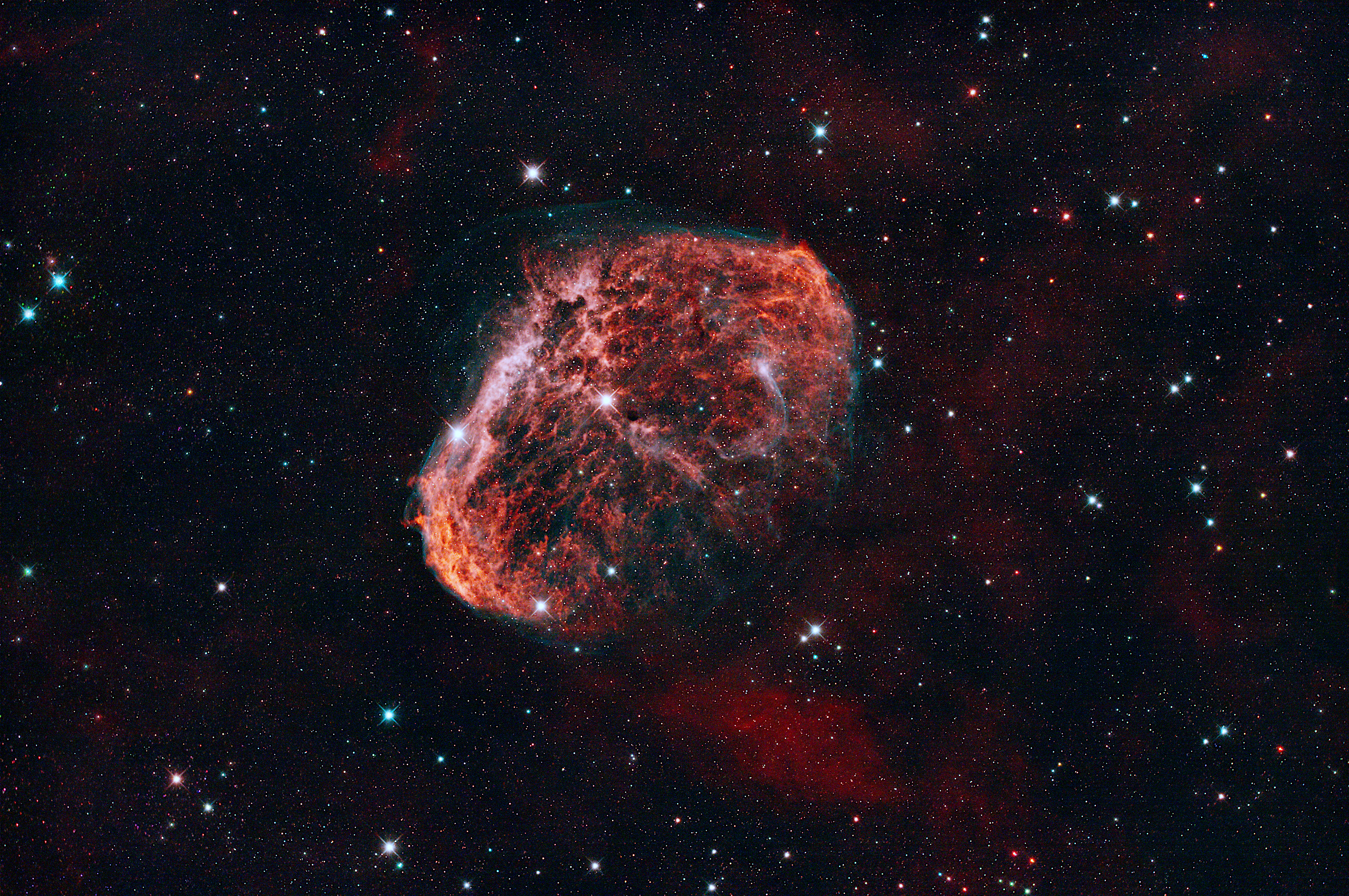
Details: Crescent Nebula, NGC 6888
◾ The Crescent Nebula is an emission nebula in the constellation Cygnus, located approximately 4700 to 5000 light-years away and spanning about 25 light-years across.
◾ It is a classic Wolf-Rayet nebula, formed by the heavy mass-loss interaction of the ultra-hot central star WR 136 (HD 192163).
◾ The shell was initiated roughly 250,000 years ago when the massive progenitor star expelled its outer envelope during a slower red supergiant phase.
◾ The nebula glows as the current, highly energetic stellar wind from the Wolf-Rayet star (traveling at ~1700 km/s) rams into this older, slower-moving gas, creating complex, shock-heated filaments and an inward-moving X-ray emitting shock wave.
◾ In narrowband imaging, ionized hydrogen (H-α) dominates the dense, intricate internal network of knots, while doubly ionized oxygen (O III) reveals a delicate, fainter outer envelope that wraps around the main structure
© 2026, Ulrich Löring, Ulm
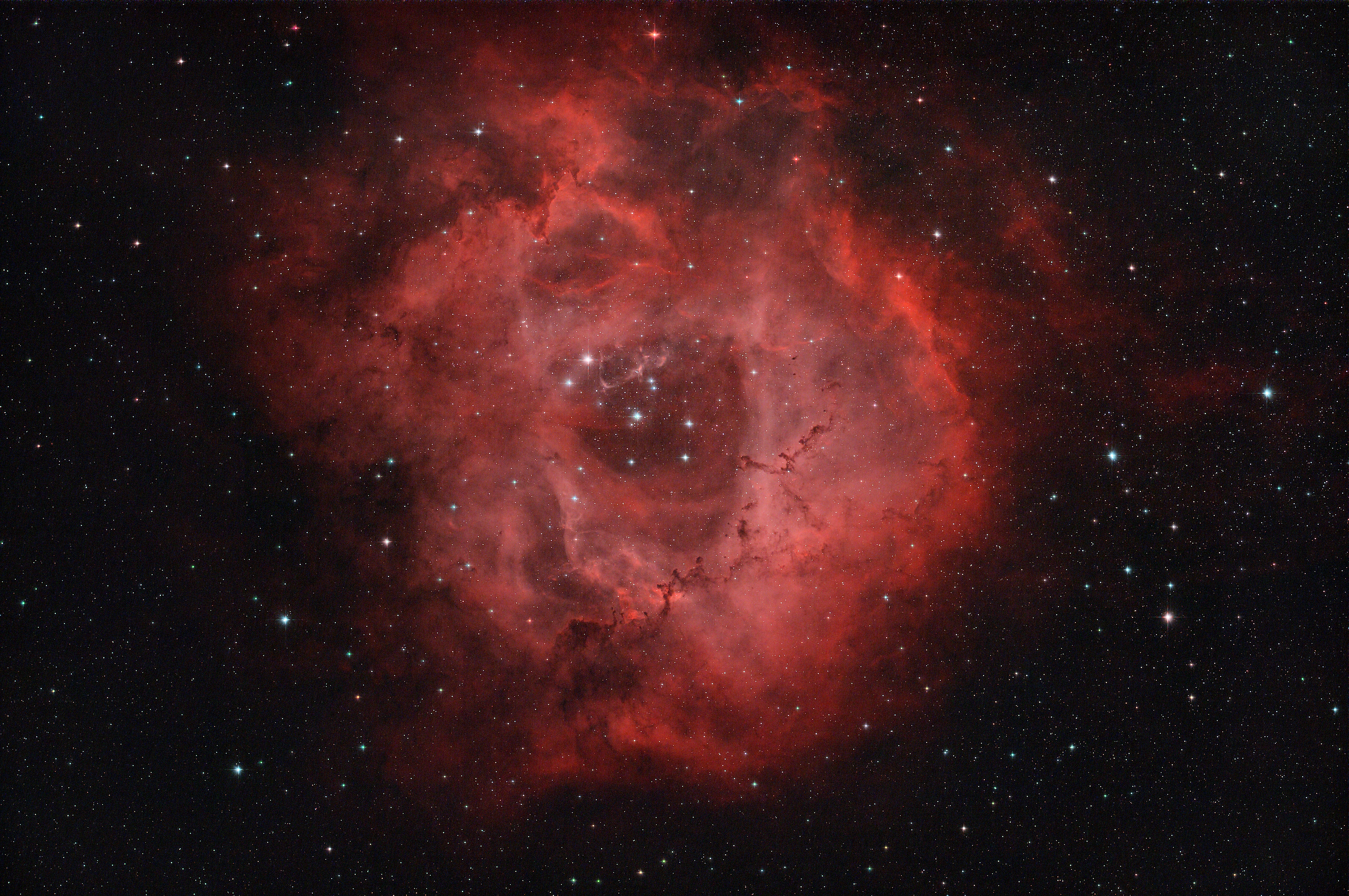
Details: Rosette Nebula & NGC 2244
◾ Located at a distance of approximately 5200 light-years, the Rosette Nebula is an extensive H II region of ionized hydrogen surrounding the young open cluster NGC 2244.
◾ The nebula is powered by the cluster’s massive O- and B-type stars. Their intense ultraviolet radiation ionizes the surrounding gas, producing the prominent H-α emission. At the same time, strong stellar winds from these stars have excavated a large central cavity.
◾ At the boundary of this cavity, compressed gas promotes further star formation. Embedded within the nebula are dark, compact Bok globules—dense molecular clumps that represent sites of ongoing protostellar formation.
◾ The structure of the Rosette Nebula reflects the combined influence of radiation pressure, gas density gradients, and magnetic fields acting on both ionized and molecular material.
(view in full resolution by clicking on the image with the mouse)
© 2026, Ulrich Löring, Ulm
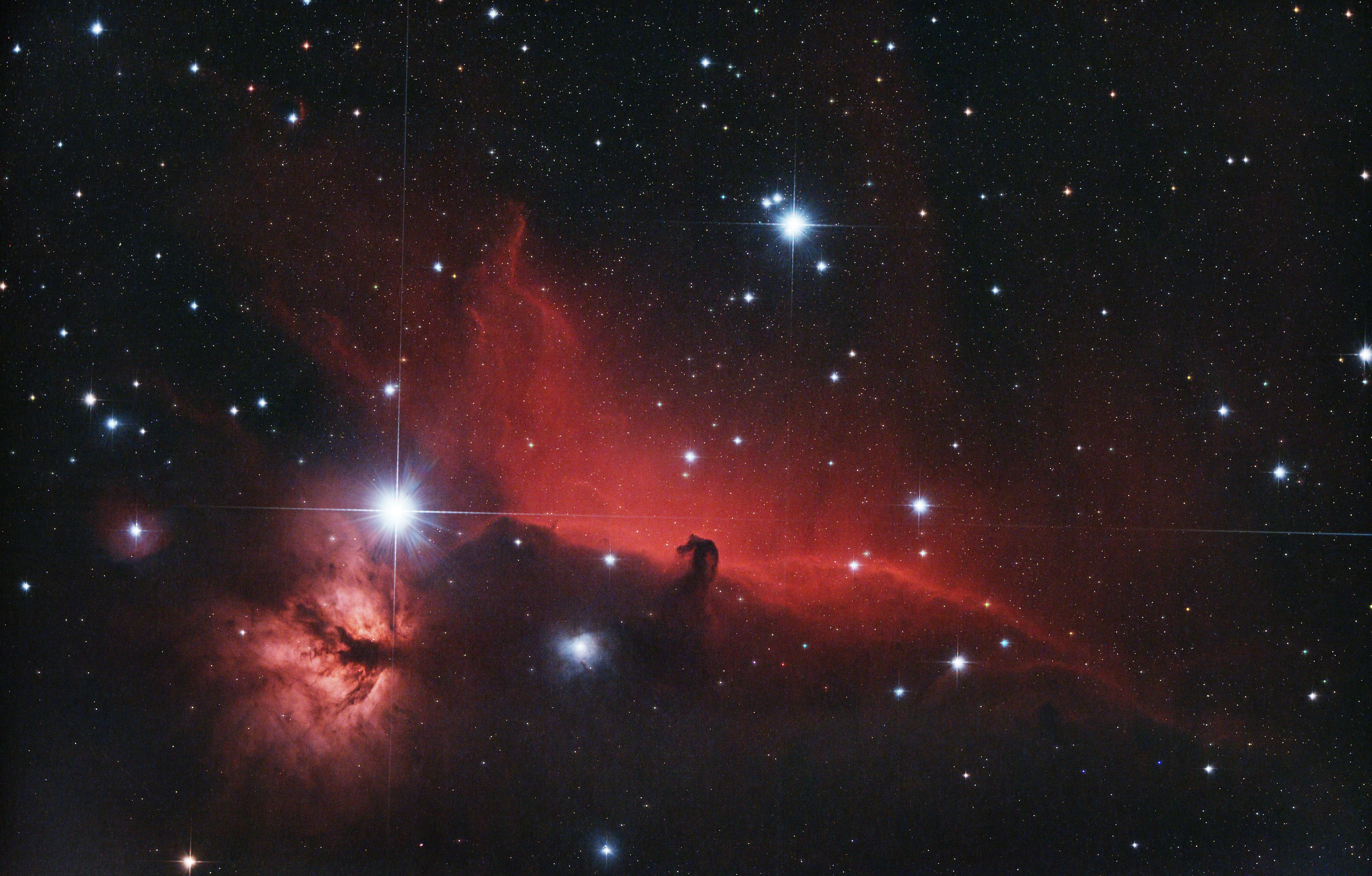
Details: Horsehead Nebula & IC 434
◾ At a distance of roughly 1375 light-years, the Horsehead Nebula is a dark nebula seen in silhouette against the emission nebula IC 434.
◾ Its characteristic shape is produced by a dense, cold molecular cloud composed of gas and dust that absorbs the background H-α emission.
The ionization of IC 434 is driven primarily by the nearby O-type star Sigma Orionis.
◾The sharply defined edges of the nebula result from ultraviolet-driven photoevaporation, as intense radiation progressively erodes the cloud’s surface.
◾ Within the densest regions, shielding from ultraviolet radiation preserves cold conditions, allowing low-mass star formation to continue.
(view in full resolution by clicking on the image with the mouse)
© 2026, Ulrich Löring, Ulm
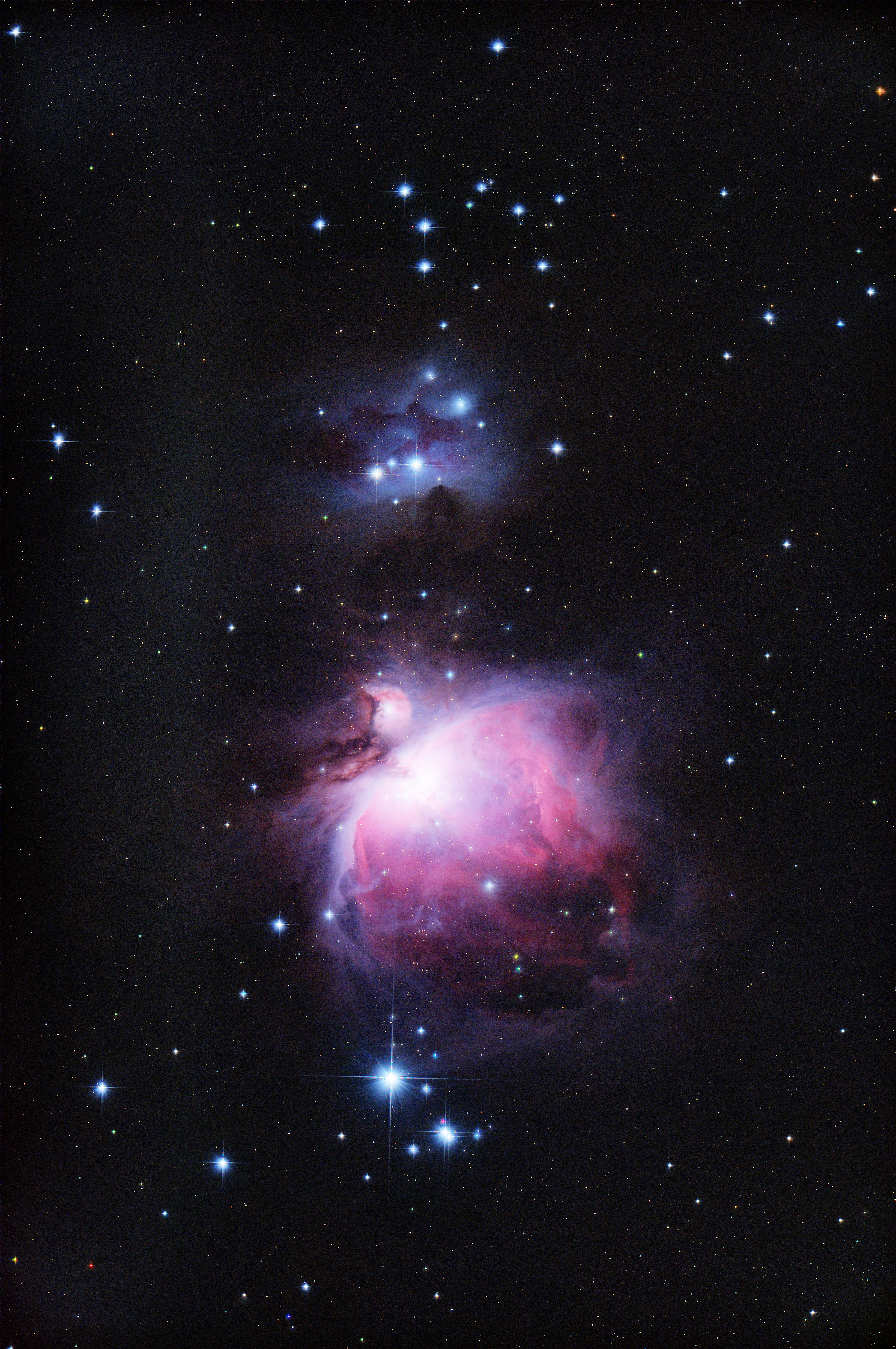
Details: Orion Nebula (M42) and Running Man Nebula (NGC 1973/1975/1977)
◾ The Orion Nebula, located about 1350 light-years away, is the nearest large H II region and one of the most active star-forming regions accessible to observation.
◾ It is illuminated by the Trapezium Cluster, whose massive stars ionize the surrounding gas. The nebula’s emission is dominated by spectral lines of hydrogen (H-α), doubly ionized oxygen (O III), and singly ionized sulfur (S II), which together define its characteristic color structure.
◾ Dark dust lanes trace dense filaments within the Orion Molecular Cloud. These regions are undergoing gravitational collapse and host protostars as well as protoplanetary disks.
◾ To the north lies the Running Man Nebula, including NGC 1973, NGC 1975, and NGC 1977. This is a reflection nebula in which blue light from nearby young stars is scattered by fine dust grains.
© 2026, Ulrich Löring, Ulm
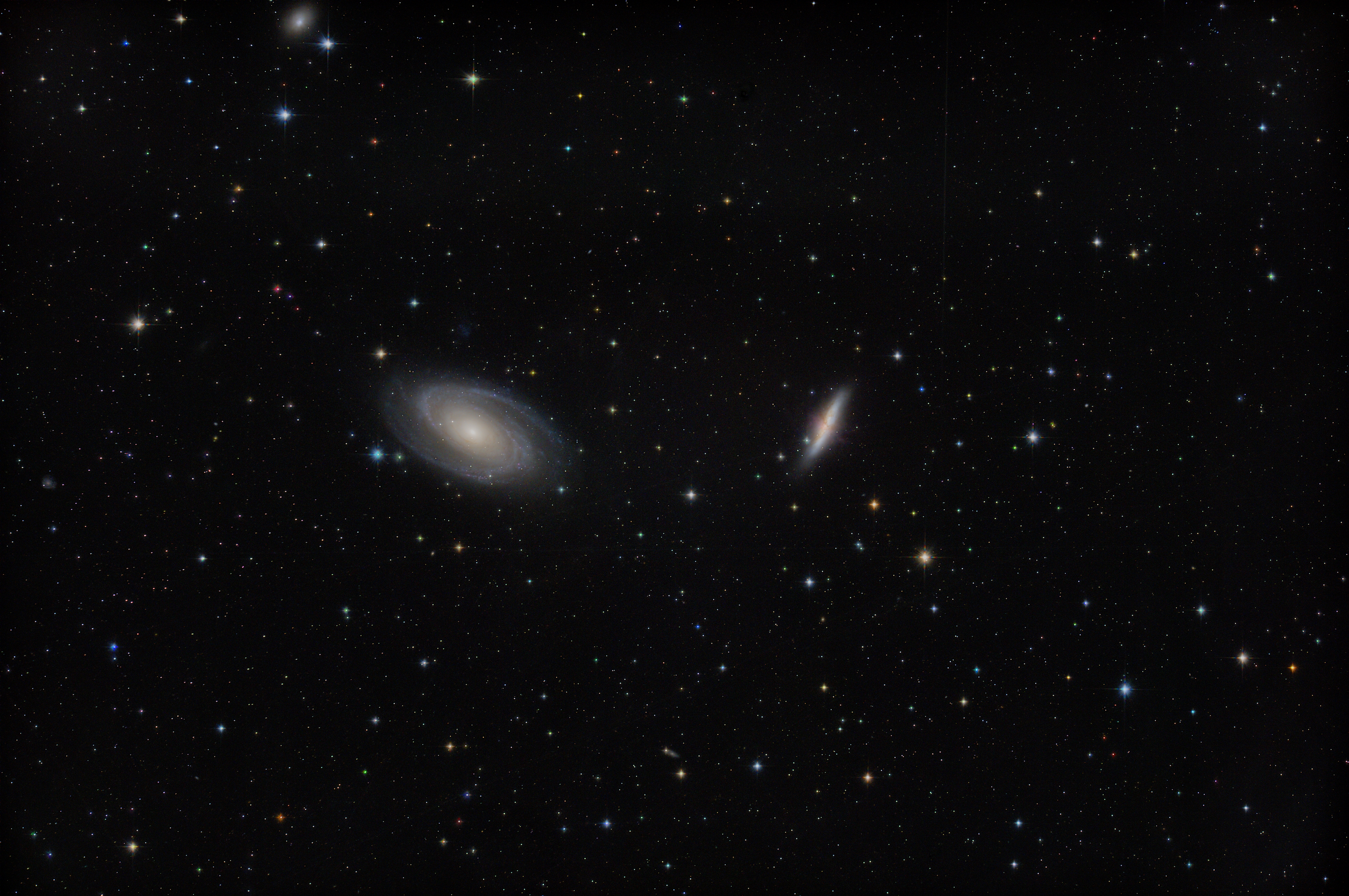
Details: Bode’s Galaxy (M81, NGC 3031) & Cigar Galaxy (M82, NGC 3034)
◾ M81, located about 12 million light‑years away, is a prominent grand‑design spiral galaxy whose well‑defined arms host numerous star‑forming regions. Its central bulge contains an older stellar population and a dynamically significant stellar halo.
◾ At its core lies a supermassive black hole of roughly 70 million solar masses, producing detectable activity in the radio and infrared.
◾ M82, the “Cigar Galaxy,” is a starburst galaxy undergoing an exceptionally high rate of star formation, triggered by a recent tidal interaction with M81.
◾ Powerful superwinds, driven by clustered supernova explosions and massive stellar feedback, expel ionized gas perpendicular to the galactic disk. These outflows are visible in H‑α, infrared, and X‑ray emission.
◾ Both galaxies are members of the M81 Group, where gravitational encounters redistribute gas, reshape galactic structure, and regulate star‑formation activity across the system.
© 2026, Ulrich Löring, Ulm
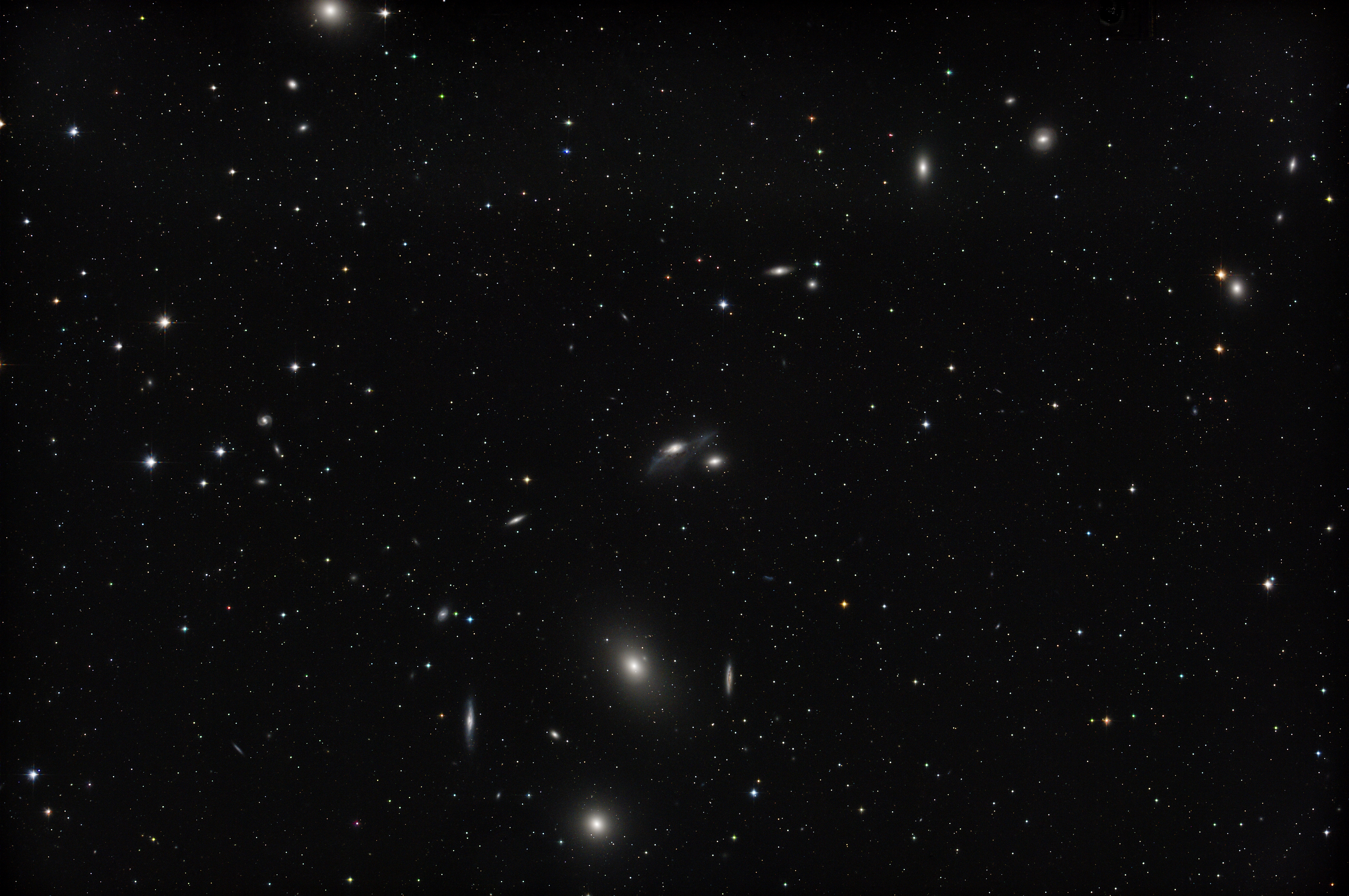
Details: Markarian’s Chain (M84, M86, NGC 4477, NGC 4473, NGC 4461, NGC 4458, NGC 4438, NGC 4435, …)
◾ Markarian’s Chain is a striking arc of galaxies within the Virgo Cluster, located approximately 50–55 million light‑years away. Its appearance results from a combination of physical association and line‑of‑sight projection.
◾ The chain is dominated by elliptical and lenticular galaxies, including M84 and M86, which contain old stellar populations and hot, X‑ray‑emitting gas.
◾ The interacting pair NGC 4438 and NGC 4435 (“The Eyes”) exhibits distorted morphologies caused by tidal encounters and ram‑pressure stripping as they move through the dense intracluster medium.
◾ High galaxy velocities within the Virgo Cluster lead to frequent gravitational encounters, gas removal, and suppressed star formation, shaping the evolution of many member galaxies.
◾ Markarian’s Chain illustrates the complex environmental processes—tidal forces, hydrodynamic interactions, and cluster dynamics—that govern galaxy transformation in dense cosmic environments.
© 2026, Ulrich Löring, Ulm
© 2026, Ulrich Löring, Ulm
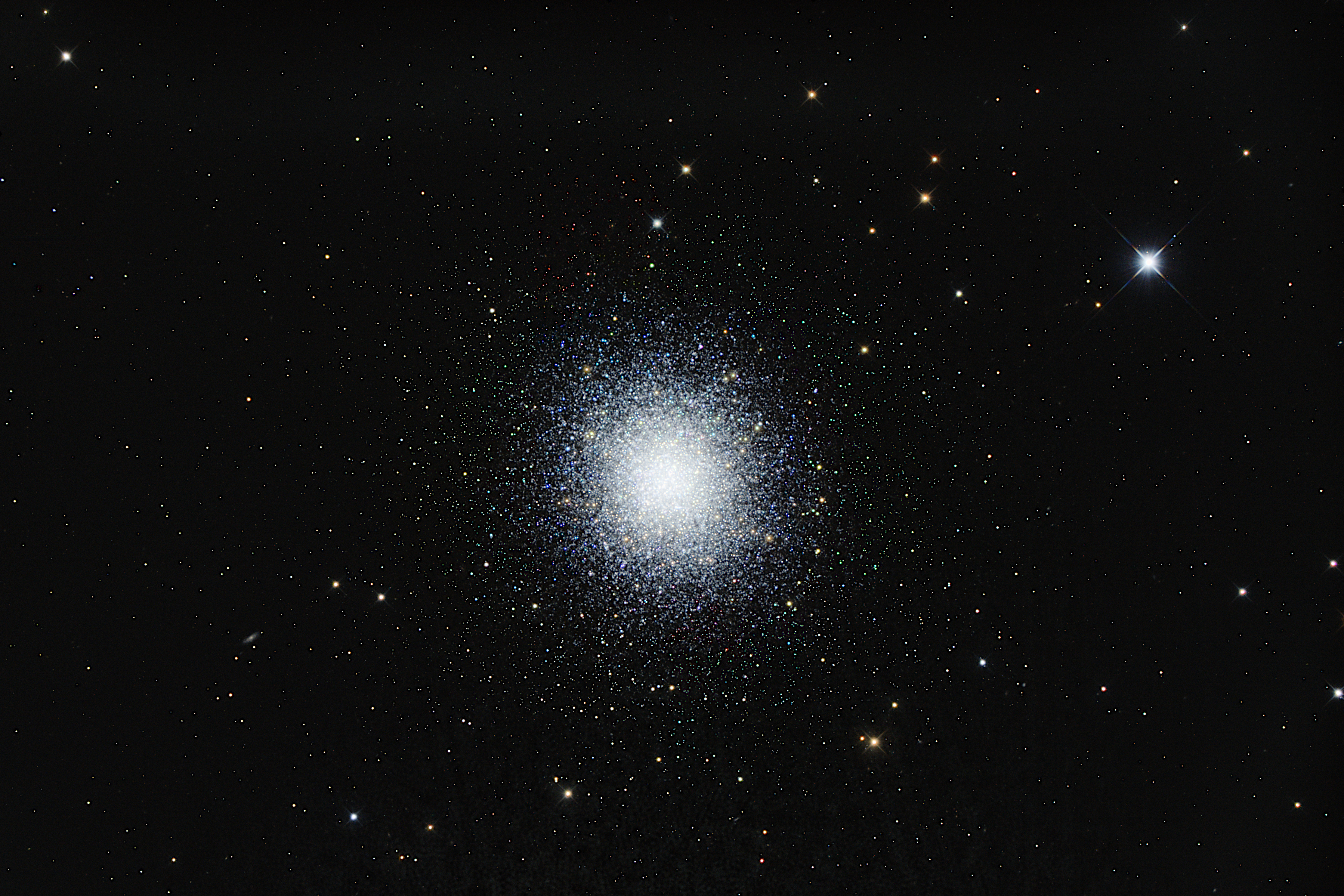
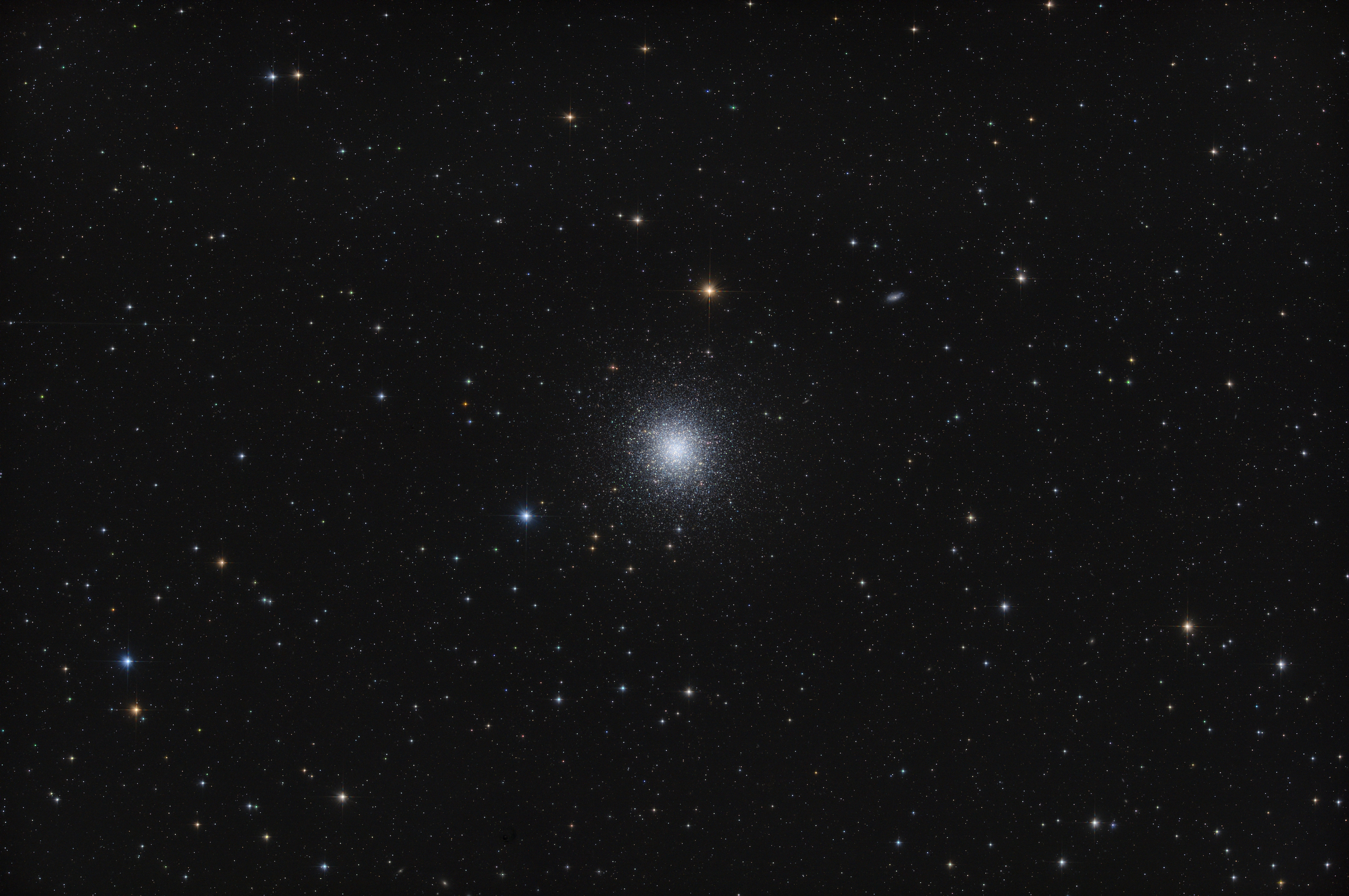
Details: Hercules Globular Cluster (M13, NGC 6205)
◾ M13, located roughly 22,000 light‑years away, is one of the brightest and most massive globular clusters in the northern sky, containing several hundred thousand stars.
◾ Its stellar population is predominantly old and metal‑poor (Population II), providing insight into the early formation history of the Milky Way.
◾ The cluster exhibits strong mass segregation, with heavier stars concentrated toward the core due to long‑term dynamical relaxation.
◾ M13 hosts numerous RR Lyrae variables, red giants, and blue stragglers, the latter likely formed through stellar mergers or mass transfer in binary systems.
◾ Any interstellar gas originally present has long since been expelled by supernovae and stellar winds, leaving a purely stellar system with no ongoing star formation.
© 2025, Ulrich Löring, Ulm
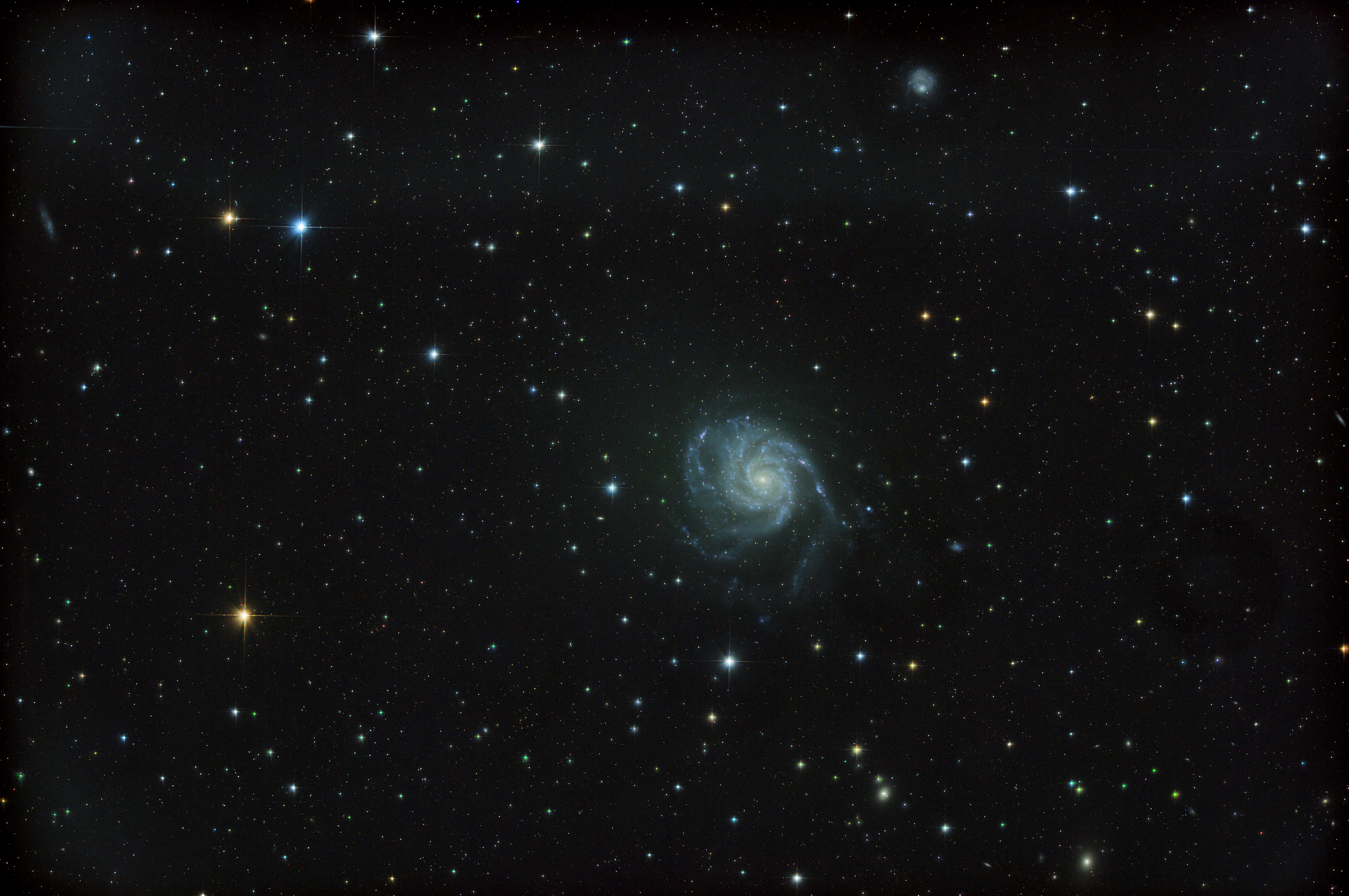
Details: Pinwheel Galaxy (M101, NGC 5457)
◾ The Pinwheel Galaxy (M101) is a face-on spiral galaxy at a distance of approximately 21 million light-years.
◾ Its loosely wound spiral arms contain numerous H II regions, indicating sustained star formation. Blue regions trace young, massive stars, while reddish knots correspond to ionized gas clouds.
◾ Asymmetries in the galactic disk suggest gravitational interactions with nearby satellite galaxies. Dust lanes absorb starlight and outline reservoirs of cold molecular gas.
◾ The central bulge contains an older stellar population and is believed to host a supermassive black hole.
© 2025, Ulrich Löring, Ulm
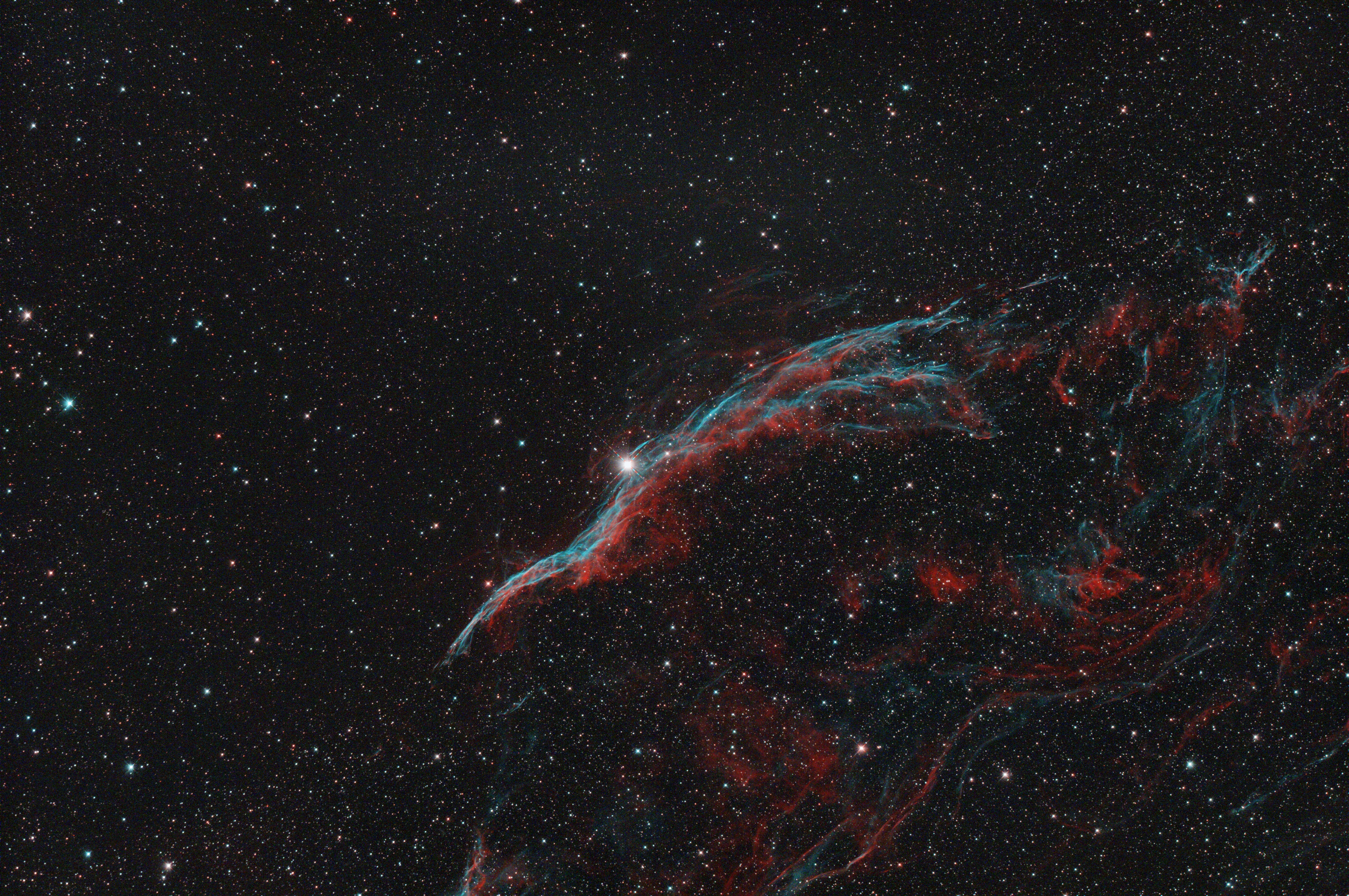
Details: Western Veil Nebula (NGC 6960)
◾ The Western Veil Nebula is part of the Cygnus Loop supernova remnant, located approximately 2400 light-years away.
◾ It originated from a supernova explosion that occurred roughly 10000 to 20000 years ago. The expanding shock wave interacts with the surrounding interstellar medium, producing thin, filamentary structures.
◾ Emission from doubly ionized oxygen (O III) appears blue-green and indicates high-velocity shocks, while hydrogen alpha (H-α) traces cooler, slower-moving regions.
◾ The observed filaments are shaped by variations in density and the alignment of magnetic fields within the surrounding gas.
© 2025, Ulrich Löring, Ulm
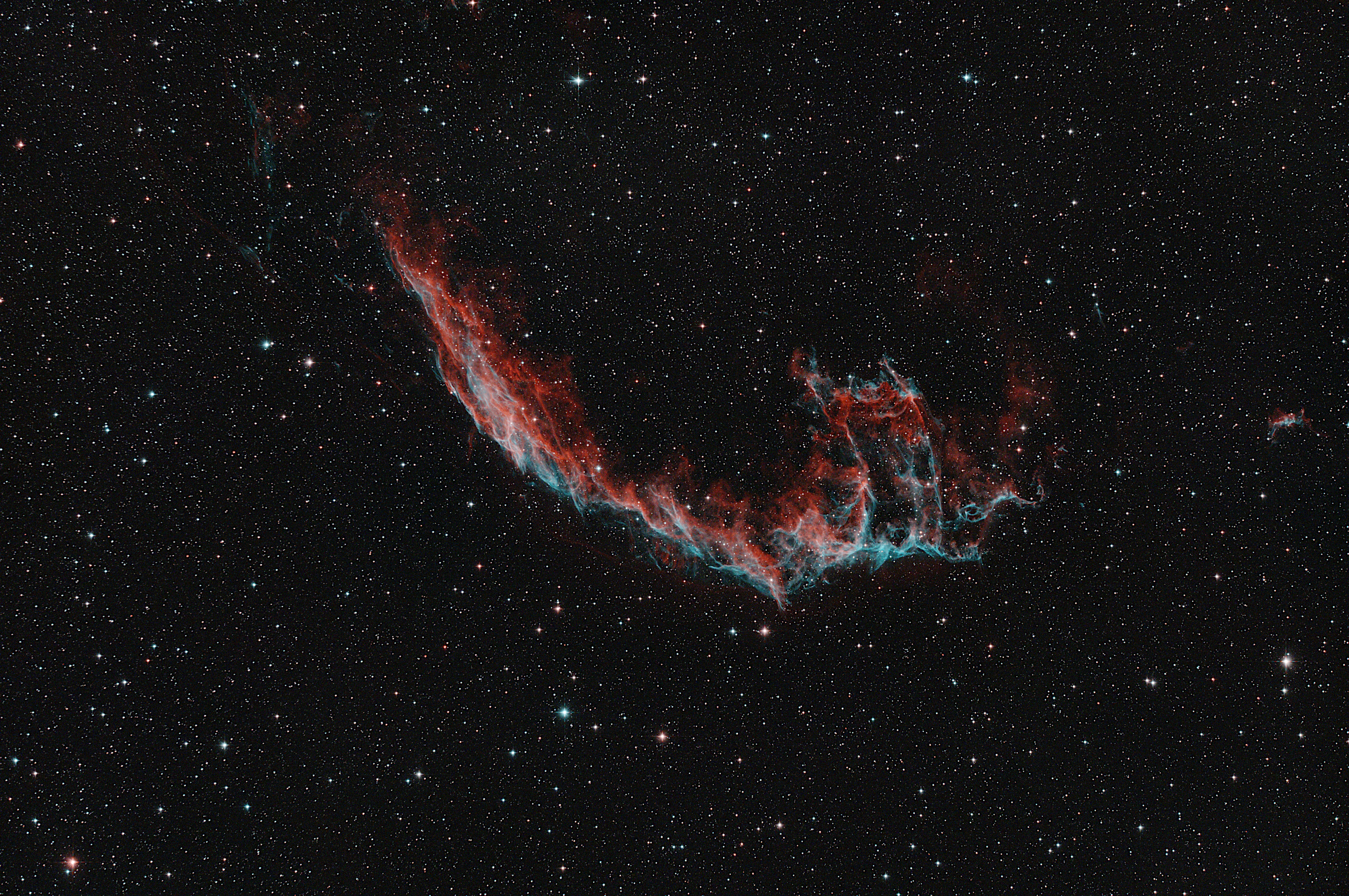
Details: Eastern Veil Nebula (NGC 6992)
◾ Also part of the Cygnus Loop and located at a similar distance, the Eastern Veil Nebula represents another region of the same supernova remnant.
◾ Here, interaction with denser regions of the interstellar medium produces more complex and highly structured filaments. Strong O III emission again highlights fast shock fronts and highly ionized gas.
◾ Variations in color across the nebula reflect differences in temperature, density, and ionization state within the expanding shell.
© 2025, Ulrich Löring, Ulm
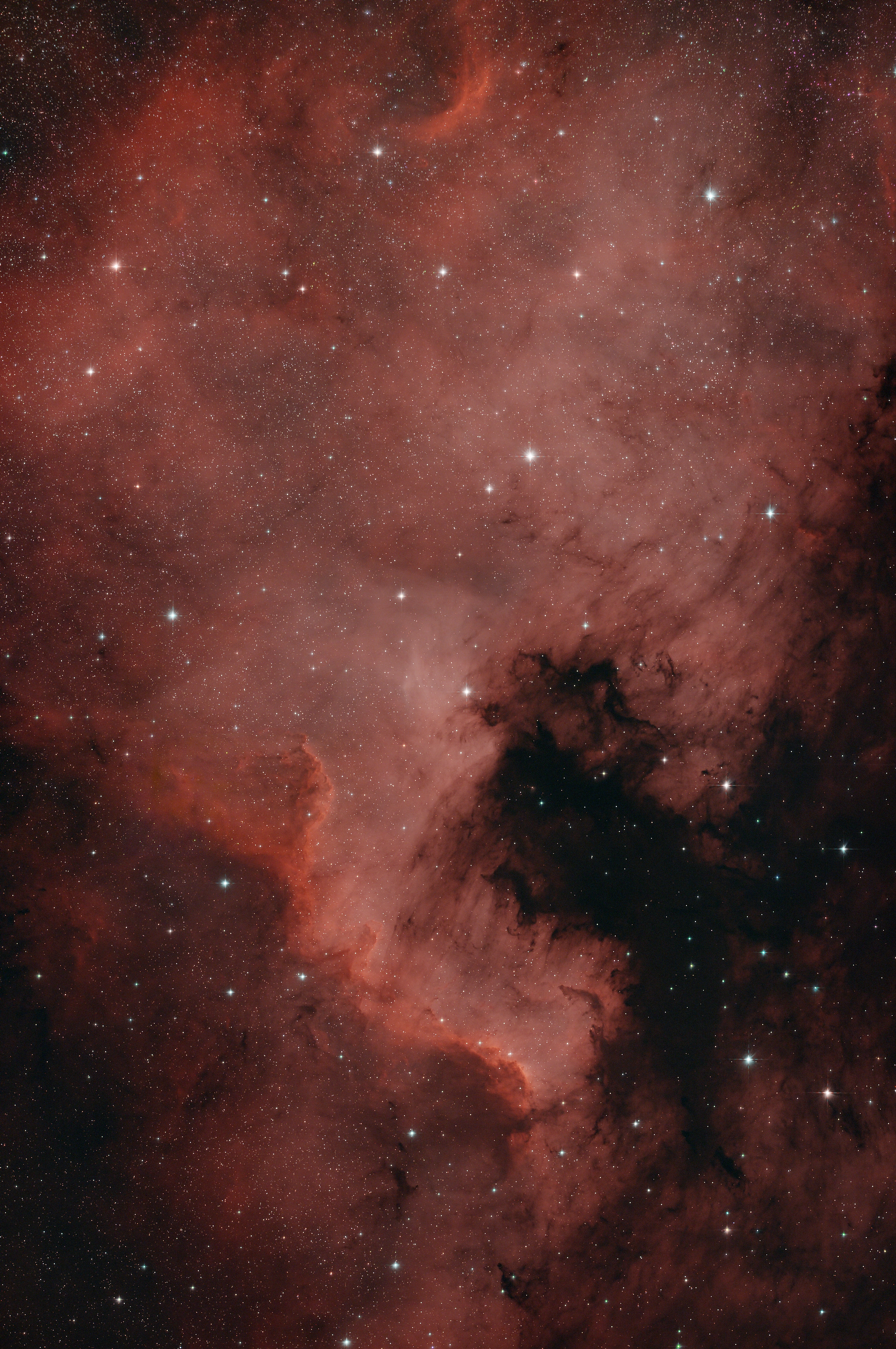
Details: North America Nebula (NGC 7000) & Cygnus Wall
◾ The North America Nebula (NGC 7000) is an extended H II region located about 2600 light-years away, characterized by active star formation.
◾ Ionization is driven by nearby massive stars, most likely associated with the stellar grouping Cygnus OB2. The nebula’s red emission is dominated by H-α radiation from ionized hydrogen.
◾ The Cygnus Wall marks a dense molecular ridge where star formation is ongoing. Dark dust lanes absorb background starlight and define the nebula’s large-scale structure.
◾ Bright edges indicate regions where ultraviolet radiation erodes the gas, forming photodissociation fronts at the boundary between ionized and molecular regions.
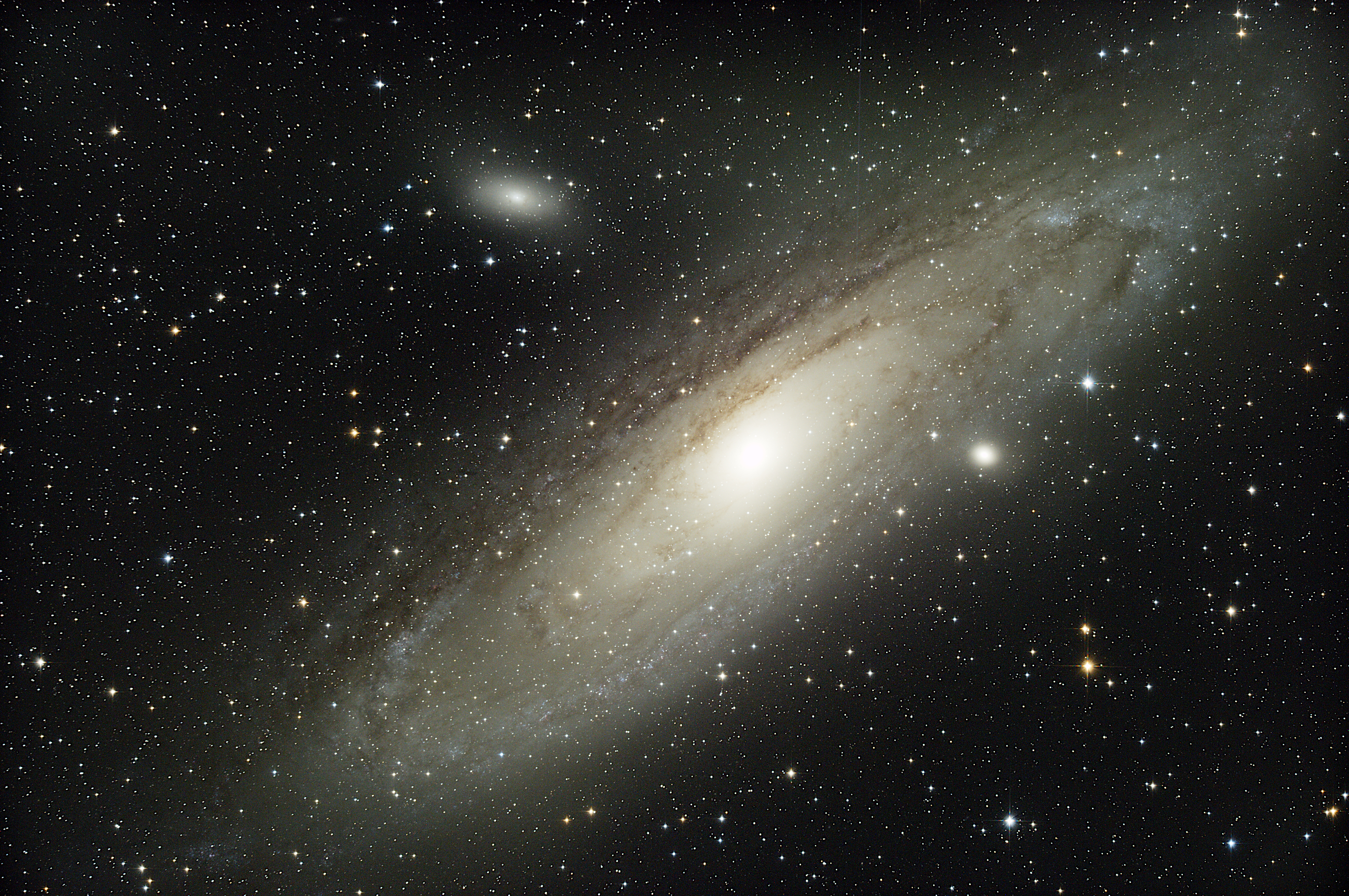
© 2025, Ulrich Löring, Ulm
Details: Andromeda Galaxy (M31, NGC 224)
◾ The Andromeda Galaxy, at a distance of approximately 2.54 million light-years, is the nearest large spiral galaxy and a dominant member of the Local Group.
◾ Dark dust lanes trace cold molecular clouds within its disk, absorbing starlight and enhancing structural contrast. The spiral arms host young, blue stellar populations (Population I), while the central bulge is dominated by older stars (Population II).
◾ A supermassive black hole resides at the galaxy’s center. Surrounding it is a system of globular clusters that records its long evolutionary history.
◾ The Andromeda Galaxy and the Milky Way are gravitationally bound and are expected to merge in several billion years.


© 2026, Dr. Ulrich Löring, Ulm